
Concrete Pumps (CCP)
VHIREL Equipment
Concrete Pumps (CCP)
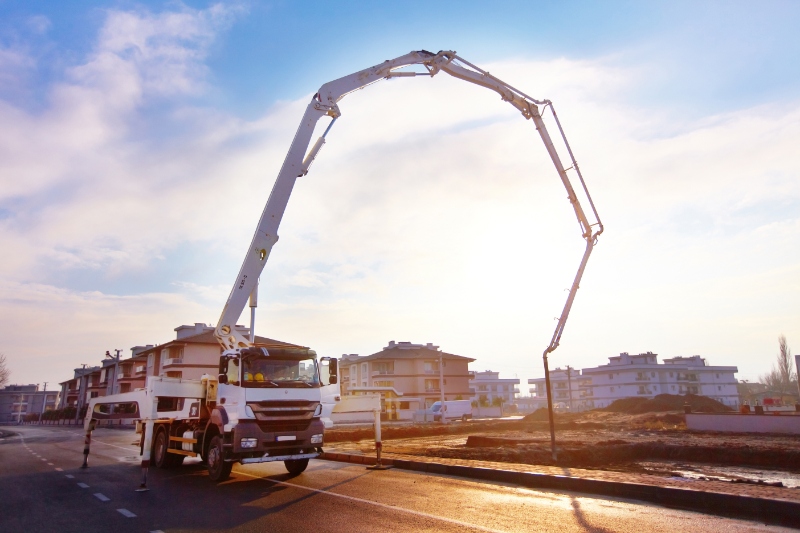
Definition:
A Concrete Pump is a crucial piece of equipment utilized in construction and related industries, providing a critical service for a diverse client base from small construction companies to large-scale developers, and appreciated by industry experts for its role in efficient and accurate concrete placement.
The Concrete Pump is a machine designed to transport liquid concrete by pumping it, under pressure, from a source like a concrete truck to the place where it is needed on a construction site. This is especially useful when the site is hard to reach, such as high-rise buildings or large slabs where a concrete truck cannot access.
Key components of a Concrete Pump include:
Hopper: This is where the concrete is poured from the concrete mixer. It acts as a reservoir feeding the pump.
Pump: Driven by a hydraulic or diesel engine, the pump creates a suction that can move the concrete through the pipes.
Valves: These control the direction of the concrete flow. Two commonly used types are “S-valves” and “ball-valves”.
Boom: Some concrete pumps, known as boom concrete pumps, have a hydraulic arm which helps in directing the pipeline to the exact location. The length and articulation of the boom can vary depending on the pump model.
Pipeline: Made up of steel or flexible hoses, this is where the concrete travels from the hopper to the pour site. The diameter and length can be adapted to the project’s needs.
Controls: The operator uses these controls to manage the direction and flow rate of the concrete. They can be manual or remote-controlled.
Outrigger: These stabilizing legs extend out from the pump truck to provide stability during operation.
Concrete Pumps are invaluable for tasks that require a significant volume of concrete to be placed within a short timeframe, or when the pour site is difficult to reach with standard mixing trucks or chutes. They are typically used in the construction of large foundation slabs, high-rise buildings, long-distance concrete pumping, or in situations where a concrete truck cannot reach the pour site.
When selecting a Concrete Pump, factors to consider include the required pumping capacity, the length of the pipeline, the type and reach of the boom, and specific project requirements. As a key element in the efficient delivery and placement of concrete, a Concrete Pump is a vital tool for a wide array of clients within the construction industry and related sectors.
They are generally classified by their pump capacity (usually measured in cubic meters per hour), maximum vertical and horizontal reach, and the type of terrain they are designed to navigate. Here are five general classifications:
Trailer-Mounted Concrete Pumps: These pumps typically have a pump capacity of up to 40 cubic meters per hour and a maximum vertical reach of 50 meters. They are designed for small to medium tasks on smooth terrains, such as residential or small commercial construction.
Small Truck-Mounted Concrete Pumps: Usually have a pump capacity between 40 to 80 cubic meters per hour and a maximum vertical reach between 50 to 70 meters. These pumps are suitable for a variety of terrains and are used in medium-scale construction projects.
Medium Truck-Mounted Concrete Pumps: Generally, have a pump capacity between 80 to 120 cubic meters per hour, with a maximum vertical reach of 70 to 90 meters. These machines can handle a wider range of terrains and are suitable for larger construction projects.
Large Truck-Mounted Concrete Pumps: These typically have a pump capacity between 120 to 160 cubic meters per hour, with a maximum vertical reach ranging from 90 to 120 meters. They are designed for heavy-duty tasks on varied terrains, often found in large-scale construction projects.
Super-Duty Truck-Mounted Concrete Pumps: These are the largest concrete pumps, often with a pump capacity over 160 cubic meters per hour and a maximum vertical reach exceeding 120 meters. They’re used for extensive tasks in challenging conditions and are capable of handling various terrains.
Health and Safety Considerations for Concrete Pumps
Operator Training: Only trained and certified personnel should operate a concrete pump. Training should include not only the mechanical aspects of the machine but also safety measures, risk assessment, and emergency response.
Pre-use Inspection: Before using a concrete pump, operators should perform a thorough check to ensure it’s in good working condition. This includes inspecting the pump, pipeline, and discharge hoses for any damage or leaks.
Stability: Stability is crucial when operating a concrete pump, particularly those with a boom arm. Outriggers should be fully extended and set on stable, level ground.
Safe Zone: Always establish a safe zone around the concrete pump. No personnel should be allowed within this zone while the pump is in operation to avoid injury from unexpected hose movements or blowouts.
Pipeline Security: All pipeline and hose connections must be secure. Always use safety straps or harnesses to prevent uncontrolled movement if a connection fails.
Personal Protective Equipment (PPE): Operators should always wear appropriate PPE, including hard hats, eye protection, gloves, high visibility vests, and steel-toe boots.
Noise and Vibration: Regular exposure to the high noise levels and vibrations from concrete pumps can lead to health issues. Operators should take regular breaks, and if necessary, use ear protection.
Regular Maintenance: Regular maintenance checks should be performed on the concrete pump to prevent mechanical failure and ensure safe operation.
Safe Disposal of Residual Concrete: Always ensure safe procedures are in place for disposing of residual concrete, to prevent environmental contamination and slip/trip hazards.
Fall Protection: If the pump or the pipeline needs to be accessed at a height, fall protection measures should be in place.
Emergency Shutoff: Always ensure the emergency shutoff is working correctly and is easily accessible. In the case of a blockage or mechanical failure, quick shutoff is necessary to prevent injury or equipment damage.
Hose Whipping: Hose whipping is a dangerous situation that can occur when air gets trapped in the delivery pipes. Operators should be trained on how to prevent, identify, and respond to this hazard.
Never operate the Concrete Pump under the influence of drugs, alcohol, or when feeling fatigued.